Camp Creek Blog

What to do if you hate your child’s interest

Published by Lori Pickert on May 30, 2013 at 08:40 AM

Holly made this comment on the sliver post:

[My son] still goes straight for the t.v. as soon as he walks in the door after being out. He still heads straight there as soon as “school-time” is over. Again, my bias gets in the way here, but I start to go crazy! Really, how many episodes of SpongeBob can one person endure?!

I guess the fact that he chooses to spend his time watching t.v. gets me the most. I’ve noticed that a lot of commenters mentioned Minecraft or other strategy-type games. I could probaby get behind that much more so than something as passive as t.v. watching (e.g., SpongeBob!!). I liken it to the parent who constantly provides entertainment for his/her child. In this case, it’s the t.v. constantly providing entertainment and he’s become totally dependent on it.

Just venting here a bit (sorry for that), but I do wonder if you have any advice or wisdom to share?

If you can’t stand the thing that your child is most interested in — or if you can’t see any real value in it — these are my suggestions for things you might think about or try:

- Look at what you WISH he was doing and then build that into your everyday life. Do those things together as a family. (This is the essential message of the sliver post.) Then you know his day contains those elements as well as TV — and it helps him see himself as someone who has more interests, more experences, and more potential.

- Imagine the ways SpongeBob might connect to activities you would be happier about. Would you be happier if he was writing Spongebob stories? Learning animation? Drawing comics? Is Spongebob really the problem, or is the problem that he isn’t oriented toward making and doing?

- Make sure he has the time and the raw materials to make and do. Does he have a workspace and materials? Are they clean and attractive and enticing? Does he have a desk or table in a place he wants to work (not off in a part of the house where he’d be by himself)? Does he have enough free time to watch TV and pursue other interests?

- Start journaling to identify his strong interests and carve out some dedicated project time. This includes SpongeBob and other interests as well. Open up a space in your life that is focused on helping him take those interests further.

- Sit down and watch SpongeBob with him. (You can just watch one episode.) Have him tell you about it. Ask him about his favorite characters and his favorite episodes. Dig into what he likes. The important thing isn’t SpongeBob — the important thing is connecting with your son, letting him see that you care about what he likes, respecting what he enjoys, and letting him know you want to know more about him and what interests him. You’ll also be able to start dissecting his interest and figuring out if there’s something you can help him explore further in a more active way.

- Make sure he has the ability to produce the media he likes to consume. Break his interest down and think about the component parts. Somewhere down the road, he might produce a podcast or a Youtube show. Right now, he might write his own original story or script, make a storyboard, learn how to do animation, make a flip book, draw a comic, put on a puppet show or skit, and so on.

Because everything is connected, it’s difficult to find ANY interest at all that a child has that can’t connect to books, films, community resources, hands-on making and building, websites, experts, writing, programming, and on and on. Roller-coasters connect to physics and design and business. Minecraft connects to programming and city planning and strategy. Spongebob connects to storytelling and animation and art. His interest is a point of entry that you can help him take in many different directions.

It’s easier to see the rich learning potential of an interest like bugs or dinosaurs or the human body. You nod and say, ah, science. I heartily approve. Yes, let’s explore this educational topic. Onward, ho!

It’s not so clear when your child has an interest like princesses or pirates or SpongeBob. You say, er, hmm. Well. Surely you have other things, better things, you want to learn about. Bugs? Anyone interested in studying bugs?

But when you start shutting down interests, you lose the child because he figures out very quickly that it’s not about him. It’s not about what he likes and what he wants to do. He isn’t in control of this time and these resources, and his interests are being judged as unworthy. That’s not a recipe for an excited, self-confident learner.

If you hate what your child likes, he may not understand enough to separate “Mom hates SpongeBob but she might like some other thing I like.” He may think, “The things I like are dumb.” He may just decide to keep his interests to himself. And if he feels like his interests do have value — whether it’s SpongeBob or Minecraft, comic books or Pokémon — and you loudly declare they have no value, then you’ve created a big dead spot where the two of you can’t share, can’t come together, can’t communicate, can’t understand one another. If you stay open to your child, you can approach any interest as a spark that can start a whole new rich line of inquiry. You can say

“Tell me about what you like. Explain that to me. Show me. How does it work? How would you do it?”

and so on.

If you’re open to it, his interest can be a starting point that goes everywhere. If you’re closed to it, then it’s a shut door and he may not take it further on his own, but even if he manages, you’re unlikely to hear much about it.

The most important thing is to take the focus off whatever he’s interested in that you don’t like and instead plow your energy into building up the making, doing, creating, thinking, learning part of your life. If a child is interested in SpongeBob but doesn’t know what to do with that interest other than sit back, get comfy, and watch episode after episode, then that’s what they’re going to do. If you make a space for digging into his interests and exploring different ways to express what he knows, he might draw Spongebob, write Spongebob stories, sew a SpongeBob doll, screen-print a SpongeBob shirt, make SpongeBob stop-motion animations with SpongeBob legos, and on and on.

You see how this works: It’s the bigger context that matters, and that’s what needs to change. Once the elements are in place for a life focused on digging deep, exploring, making, doing, and sharing, any interest will be explored in a meaningful, active way. And when he switches interests, he takes his skills (and his mentor) along with him.

Now, if your child has a lot of interests, you get to pick and choose what to invest in, and it makes sense to support something that you think is worthy of deep, prolonged study. And you may as well steer away from the things that you have a real distaste for. But I like to think that any parent who really gets experience mentoring their child’s self-directed learning will become more and more interested in their child and what they care about. The more you do this, the less likely you are to easily dismiss something they really care about. You’ve discovered how deep and complex learning born out of self-motivation and authentic interest can be. That’s what I think — that’s what I hope!

Stay open to what he cares about and design a life that is focused on the things you care most about. You won’t go wrong.


Also check out: Video games can actually give you ideas (guest post by my son)

After reading my posts on abundance, a few people asked:

If we provide children with more materials, will they still learn to share?

Here are my thoughts.

Too often, we concentrate on teaching lessons through negative means: forcing children to apologize (often after putting them in a Lord of the Flies situation in the first place), forcing kids to share stingy resources, and so on. Then we tell ourselves that they’re learning necessary lessons about how to treat others.

In reality, generosity is more likely to produce a generous person. Stinginess is more likely to produce a child who is hell-bent on getting his fair share.

Demanding that children share ignores their feelings and does not truly teach them to share. It more likely teaches children to feel angry and resentful toward adults and to believe that sharing is always accompanied by emotional pain. The irony of sharing is that when children know they are not required to share, they are more likely to do so! — Teaching Children to Share

Will children raised with abundance learn how to share?

When we buy more butterfly nets or more wooden trucks, we aren’t focusing on abundance just to stop children from squabbling. We are investing in abundance (by making thoughtful choices) in order to allow the children to do more.

Instead of sharing wooden trucks, they are now sharing ideas.

Instead of sharing butterfly nets, they are sharing butterfly-catching strategies.

Children will still learn to share, because to do anything with others requires cooperation, collaboration, discussion, identifying and solving problems, and on and on. The point is to get to this richer area of learning that is completely blocked by an initial lack of abundance: not enough time or materials for the children to do anything meaningful or complex, for them to work together, for them to focus on something more important.

It doesn’t work to use punitive measures to teach children to be loving, kind, generous, compassionate, empathetic. In order for children to develop these traits, they have to grow up being treated in a loving, kind, generous, compassionate, and empathetic way. Whatever you want your child to develop within himself should be a big part of his environment.

We are so used to the idea that children must be forced to share, forced to apologize, punished for disagreeing, and so on, that we lose the opportunity to help them develop strong emotional intelligence, self-awareness, generosity, compassion, kindness, cooperativeness, and so on simply by raising them in a peaceful environment that focuses on doing meaningful work.

Please understand me: I am not recommending that parents ignore their children’s bad behavior and let them do whatever they like. I am recommending that you embody the traits you would like your child to develop. I am saying that focusing on abundance creates meaning and purpose — it allows your child to stop hyper-focusing on who has what and how much is left and who’s turn it is and move into a much richer area of making, doing, talking, sharing, extending ideas, helping, solving problems, and teaching.

Decide which areas of your life are important and worthy of investing in and creating abundance. Decide which areas of your life are less meaningful and simply stop investing your time and money there. Children absorb so much from how you live and the choices you make. Be thoughtful about those choices. Simplify your life in a way that shifts your resources to your deepest values.


Friday link round-up

Published by Lori Pickert on May 25, 2013 at 08:02 AM

The best thing I have to share this week (with permission!) was a post in the forum by a mom who worked past her initial misgivings about Minecraft in order to support her son’s deep interest — and had a great outcome:

“I’m new to pbh and still anxious about how it will all work; especially since both my boys love minecraft. The other day during our project time my 10 yr old was simply building on minecraft and I had to continually bite my tongue b/c that little voice in my head was telling me, “this is not education!”. However, I persevered. :)

I grabbed a notebook and just started asking him what he was doing. Lo and behold he was building giant forks, shovels, question marks, dollar bills, etc. I made the observation that there are artists that create actual sculptures just like that. Before I knew it, both boys were looking for images on google, discovered the artist was Claes Oldenberg, and we were talking about what was interesting about the art. That led to a discussion of art in context and I posed the question of what giant sculpture would be appropriate in the context of our house. They came up with several ideas, but decided they would build a life-sized Steve from minecraft. I asked what they needed, we gathered supplies. I jotted down ideas they came up with. They came up with the idea to hide binary code in their statue since steve is created by code. We went to the library and they worked with the librarian to hunt down books on Oldenberg. My oldest also got several books on architecture as well for inspiration for building and has immersed himself in that and has built some awesome buildings and is learning a ton about architecture.

I truly see the value of journaling. It is eye opening how much they learn. The math concept of median was used in the building projects. They were measuring and figuring out scale. They were working together and not fighting. As I write all they are doing I see all the different directions they could take this. It’s very exciting to watch. Thanks for all the encouragement and advice this blog provides.”

I love hearing these stories. If you’re a member of the forum, we share them in the small wins thread — it’s important to take a moment and celebrate your successes as you learn to mentor yourself and your kids to your best lives. Even a small change — like taking a pause and getting out your journal, asking a few questions — can make a huge difference in your learning life.

And have you seen O’s amazing Minecraft project on PBH Kids? If your kids have project work they’d like to share, let me know!

I liked this article on project-based learning (as manifested in schools) mostly for this teacher’s reaction to helping kids direct their own learning:

“‘[E]ngaging kids in project-based, deep-thinking types of learning that I saw in Finland … that’s what we tried to replicate in our state,’ Paine said. And not coincidentally, just the kind of pragmatic, complex, collaborative problem-solving that companies say they need in the 21st century workplace. …

“The first [project-based learning] project I did — after it was done — I said I would never go back to the old way of teaching, because it was that valuable.’”

‘I wanted to cry because I could see how much progress they had made from beginning to end.’

You might want to follow my project-based learning board on Pinterest. I think we can glean some insights and ideas from what traditional education is trying to accomplish with PBL even though we homeschoolers have the freedom to take it so much further. (The board is a mix of PBL at school and at home.)

Last week I wrote a post called The Sliver, or How to stop fighting about screen time. In that post, I suggested using “generous limits” (as opposed to strict limits or no limits at all) to make it possible for your child to go beyond just being an irritable, frustrated, passive consumer and actually be in the flow, learn, and create with media.

In the comments, someone brought up studies on brain development and asked how I could dismiss those. I wrote a lengthy response, but a friend sent me a link to this article, which I think is a great addition:

“Diagnosed with moderate to severe autism at the age of 2, Jacob spent years in the clutches of a special education system that didn’t understand what he needed. His teachers at school would try to dissuade Kristine from hoping to teach Jacob any more than the most basic skills.

…

“For a parent, it’s terrifying to fly against the advice of the professionals,” Kristine writes in her memoir, The Spark: A Mother’s Story of Nurturing Genius. “But I knew in my heart that if Jake stayed in special ed, he would slip away.”

…

‘I operate under a concept called “muchness,”’ Kristine said. ‘Which is surrounding children with the things they love — be it music, or art, whatever they’re drawn to and love.’

By the time he was 11 years old, Jacob was ready for college. He’s now studying condensed matter physics at the Indiana University-Purdue University in Indianapolis.” — Boy Genius Diagnosed with Autism has IQ Higher than Einstein

And a quote from the boy himself, from his TedxTeen talk that appears at the end of the article:

“In order to succeed, you must look at everything with your unique perspective and not settle for accepting the straight facts.” — Jacob Barnett

The talk is great, and your kids might enjoy it, too.

Since we’ve been talking a lot lately about screen time on the blog (posts, comments, and in the forum), I thought this was worth sharing:

“My work with children, teachers and computers over the past thirty years has been focused on increasing opportunity and replacing ‘quick and easy’ with deep and meaningful experiences. When I began working with schools where every student had a laptop in 1990, project-based learning was supercharged and Dewey’s theories were realized in ways he had only imagined. The computer was a radical instrument for school reform, not a way of enforcing the top-down status quo. …

Used well, the computer extends the breadth, depth and complexity of potential projects. This in turn affords kids with the opportunity to, in the words of David Perkins, ‘play the whole game.’ Thanks to the computer, children today have the opportunity to be mathematicians, novelists, engineers, composers, geneticists, composers, filmmakers, etc.… But, only if our vision of computing is sufficiently imaginative.” — Technology Is Not Neutral @ for the love of learning

When Gary says “only if our vision of computing is sufficiently imaginative,” I think he means only if teachers take the time to fully explore how computers can be used by students in school. At home, I would say “only if our vision of computing is sufficiently imaginative” to see what powerful tools computers can be for mastering skills, creating original works of art, building community, and so on. If we demonize tech, we’re taking away so many of the hundred languages children can use to learn and build.

In the inspirational area, this week, I loved what Michael wrote about focusing on what we can do:

“I might dream of Sustainably Creative becoming one of the top 100 most read blogs in the world, being offered a publishing contract worth hundreds of thousands of pounds, and Oprah relaunching her chat show just to interview me. However all of those dreams require actions by other people, lots of other people (and Oprah). I can’t make those people act in the ways I might like.

However I can work on my half of the equation. I can show up and write posts regularly for Sustainably Creative. I can work on book proposals and publish my own ebooks. I can approach agents and publishers. In short I use what energy I have to focus on the work that at least puts me on the right track to fulfill my dreams.” — Achieve (almost) anything you want with a pen, paper, and a pot of tea @ Sustainably Creative

This is what it’s all about — just starting. Doing what we can. It changes your life, even if you don’t end up with what you originally thought you wanted.

Thank you for hanging out with me on PBH and being part of this community!

I have to say that being a PBH mom has helped me tremendously to see that while being there for my kids, I can support my own work and make my dreams a reality. Learning as I go. — PBH forum comment

Thank you for challenging us parents the way you continually do and sticking up for the rights of children. You know why PBH rocks above all other educational methodologies? Because it’s the only methodology I’ve encountered that requires parents to try to become the best possible version of themselves in order to walk the talk. — PBH parent e-mail

Allowing children to learn about what interests them is good, but helping them do it in a meaningful, rigorous way is better. Freedom and choice are good, but a life steeped in thinking, learning, and doing is better. It’s not enough to say, “Go, do whatever you like.” To help children become skilled thinkers and learners, to help them become people who make and do, we need a life centered around those experiences. We need to show them how to accomplish the things they want to do. We need to prepare them to make the life they want. — Project-Based Homeschooling: Mentoring Self-Directed Learners

Parenting with abundance and simplicity

Published by Lori Pickert on May 23, 2013 at 12:33 PM

This is a follow-up to my previous post, Parenting with abundance vs. scarcity.

A few people had questions for me about how abundance fits in with simplicity and even minimalism, thinking those concepts might be oppositional. Actually, they work together. Let me explain how.

Abundance requires simplicity — because in order to have abundance in one area, you must reduce something else. You can either use your toy budget to buy a roomful of random toys or you can decide to focus on investing in only two or three open-ended toys: say, wooden blocks, a wooden dollhouse, LEGO.

If you have a lot of random toys, children might fight because they all want to play with the plastic dinosaur at once; then when they tire of that, they suddenly all want to play with the nerf gun. They can’t play *together* with one plastic dinosaur. However, if you have a basket full of plastic dinosaurs, they can all play together. They can take them to the sandbox or get out the clay and make a dinosaur world. They can collaborate and cooperate and build something complex.

If you have a couple dozen wooden blocks, not only can children not play together (there just aren’t enough to share), but even one child is limited in the complexity of anything he can build — there aren’t enough blocks for complexity. He can build a small, simple structure and that’s it. He quickly reaches the limits of what he can build and he can go no further. A large variety of materials or experiences can make it seem like we’ve given our children more, but really we’ve given them less.

If you have fewer random toys and a LOT of wooden blocks, suddenly you can build something big and complex. Multiple children can work together, and there are enough materials for everyone. There are enough materials to go beyond simple ideas and simple constructions.

But this abundance requires simplifying — you can’t offer an abundance of everything. You have to choose what matters most and invest there. To offer abundance, you must thoughtfully simplify.

PBH requires focus. In order to support your child’s deep interest and help him stay with an idea longer, you have to forgo some random, unrelated activities. They might be perfectly fun activities, like a homeschool field trip to the petting zoo. But you might instead take him to the planetarium so he can stay with his interest on space. They might be perfectly fun crafts, attached to the current season or holiday. But you choose instead to help him stay focused on making planets out of recycled materials. You are forgoing variety, novelty, and width to focus instead on depth, on mastery, on becoming an expert in something he really cares about. You’re letting go of some things that are mildly fun and interesting for everyone to focus on something that your specific, unique child finds deeply engaging. You are helping him move beyond the surface of learning and dig deeper, learn more, and build new skills.

If you want your child to be able to work deeply and meaningfully, you might pare down your extracurricular activities. Another family might be doing swim lessons, tae kwon do, soccer, and ballet, while your child is goes to one art class a week at the local museum. You are making a choice for simplicity (more white space, more project time) that is simultaneously a choice for abundance (a deeper exploration of art, more time for his specific deep interest).

The main point of abundance vs. scarcity is that if you limit materials, opportunities, or experiences too much, you are ensuring that your child can only be a passive consumer. You haven’t given him enough time and support to become an active creator.

“Abundance” doesn’t mean an enormous pile of materials or a huge number of activities or a never-leaves-the-basement obsession with a particular interest. Abundance means thoughtfully paring away the less important so you can invest more time, energy, and money in what you really care about.

What is the point of simplifying your life, if it’s not so you can do more of what matters?

Parenting with abundance vs. scarcity

Published by Lori Pickert on May 18, 2013 at 07:42 AM

This week I shared how we use generous limits as a way of dealing with screen time and how that approach reflects an abundance vs. scarcity mindset.

When I owned a small Reggio-inspired school and worked as an educational consultant, I often ran into this type of problem, where emotions are high and adults and children are in opposition. No one is happy and the overarching goals are not being met.

Scarcity situation:

- Conflict arises because of a scarcity situation (or a perceived scarcity situation).

- There is intense focus around the item or experience that is felt to be scarce.

- The adult is frustrated by the child’s intense focus.

- The adult wants to “teach a lesson” through scarcity.

- Much time is spent arguing, bargaining, and complaining (the ABCs of scarcity).

Scarcity issues typically arise directly from how the adult has organized the situation. Once conflict occurs, the adult usually maintains the scarcity for a reason: because they want to teach a lesson.

Here’s a reenactment of a mentoring session I did with a preschool whose teachers had visited us. All names and details have been changed.

Sunnyside: We want our kids to be working on projects and collaborating like yours do, but all they do is fight all morning.

Me: What are they fighting about?

Sunnyside: Well, there are a lot of boys in this class and only four kids can use the block center at a time. They fight constantly about who is in the block center, whose turn it is, how long they’ve been in there, and so on. Then, even when they’re in the block center, we have two wooden trucks and they fight over who gets to use those.

Even the girls who weren’t even interested in blocks are demanding to play in the block center and demanding their turn with the trucks, just because they see the boys fighting about it. All we do all morning is referee arguments. No one is working on any projects. All they do is fight about this.

Me: What have you tried so far?

Sunnyside: We want the kids to use all the centers instead of just staying in one place all morning, so every half-hour we have them move from one center to the next one. And we have an egg timer to keep track of whose turn it is with the wooden trucks, but we get busy and sometimes we forget to check it, then they fight even more.

Me: Okay, you need to do two things.

Sunnyside: Tell us!

Me: You need to drop the limit on how many kids can be in the block center and you need to buy more wooden trucks.

Sunnyside: What?! But they won’t all fit into the block center! And giving them what they want seems totally wrong — shouldn’t they be learning how to share?

Me: Just try it, then get back to me in a week.

So here’s what happened:

- When the strict limits were taken away, all the kids did try to crush into the block center at once. There was a lingering residue of “the block center is the desired place to be.” Sixteen kids pressed around one small table and a limited number of blocks didn’t work, and the kids figured that out on their own. It was boring to stand in a crowd with hardly any blocks to play with, so after awhile, some of the kids wandered away. The ones who stayed began to negotiate how they would share the blocks.

- When the new wooden trucks arrived, the kids ceased arguing about them and started playing with them.

A week later:

Me: How’s it going?

Sunnyside: Much better. But we still have more kids who want to play in the block area than the block area will accommodate. They are crushed in there together and they’re doing pretty well, but there isn’t enough room.

Me: Make the block area bigger.

Sunnyside: Wha— [sigh] Okay.

When you have a scarcity situation, the first thing to look at is:

What am I trying to accomplish by using scarcity?

These teachers had good goals for their students:

- They wanted them to use the whole classroom and not just one center.

- They wanted them to collaborate and not argue all the time.

- They wanted them to work on long-term projects.

But their choices had made the exact opposite happen.

Instead of valuing all the areas of the classroom (art studio, library, science area, etc.), the kids were all hyper-focused on what they couldn’t have: the block center.

Instead of collaborating, they were arguing and bargaining and complaining all morning.

Instead of working on long-term projects, they were being rotated through the centers, so that even if they were involved in what they were doing, they were interrupted to move on in the name of variety. Whatever a child was building in the block area, someone else knocked down a half-hour later. Whatever a child was painting in the art studio, he had to drop it and leave — so why ever start anything complex or ambitious? Whatever book two children were looking at together, they had to put back on the shelf and move on — so no deep interests ever sparked.

The teachers were accidentally training the kids NOT to focus, NOT to invest in big ideas, and NOT to work on long-term projects. They were accidentally training them to have the opposite traits than they wanted: developing short attention spans, seeing each other as competitors rather than collaborators, and so on.

The work of figuring out how to share can’t start until children are given the responsibility and freedom to do that work. When you create a scarcity situation, you aren’t teaching them how to share, you’re teaching them how to compete hard for what’s rightfully theirs. When they are given the tools, the opportunity, and the support, they can begin to build those character traits and habits of mind you want for them.

The work of figuring out how to self-regulate can’t happen until children have enough elbow room to make some of their own choices. You aren’t teaching kids how to restrict their own screen time when you restrict it for them. There is literally not enough white space for them to give them any control or decision-making, so they aren’t building any skills. They’re just reacting emotionally to a situation that you control. How can they learn to make good choices if they don’t get the opportunity to make bad ones?

With generous limits, children find that they have to make decisions — Do I finish drawing this comic, or play Minecraft? Now they’re beginning to make choices and deal with consequences. They may make what you think are wrong choices, but mistakes are the pathway to understanding and eventual success. If they don’t have room to make mistakes, they don’t have room to learn.

Let’s check in with Sunnyside one more time:

We doubled the size of the block area and suddenly the boys started working together on a large construction. It was like magic. They started building a city, and they used all the trucks to build a garage. Once their project got going, the girls became interested and began to make suggestions and work on it as well. They are making signs in the writing center and they are using the art studio to make people and animals. Some girls are painting a backdrop for the wall; they all sat down together and talked about what it should include. They are even using the materials in the science center to make trees and bushes. We’ve put books about cities and garages in the library and they are using them for reference.

We finally have a project going, and the kids are doing the work we wanted them to do instead of fighting all the time. And we are helping them work on their ideas instead of being referees. It is wonderful. Thank you.

By the way, we had to throw away another rule. Before, they had to clean up the block area at the end of the day. The day we took that rule away, they started to build their city.

As a parent, you need to think about what you really want. Then you need to look at your choices and see if they are getting you the results you wanted or if they’re getting you something else entirely.

What parents want when they set strict screen limits (or strict limits on comic books or anything else) is for their kids to play outside, read, build things, develop intellectual hobbies, play, enjoy their family, collaborate, do more worthy activities. They want screens to be a small part of the children’s lives.

What they get is often a child who is hyper-focused on the exact thing they wanted to be least important. Suddenly the limited thing looms large and taints every other hour of the day. It’s all the kids talk about and all they think about. Arguing, bargaining, and complaining ensue.

When you employ generous limits (focusing on abundance — there is enough time for everything), focus can shift away from arguing and bargaining to what the child wants to accomplish. The focus can leave the screens. There’s no need to argue and fight, because there is enough time.

Note: “Generous limits” does not mean “no limits.” Generous limits take the pressure off and eliminate anxiety and bargaining. No limits can actually increase arguing, bargaining, and anxiety because every single thing you want to do during the day is opposed to screen time. Do you want to go to the park? No, it’s park vs. screens and screens win. Do you want to make a cardboard robot? No, it’s robot vs. screens and screens win. No limits can actually be a more fraught situation. Generous limits make time in the day for everything: outdoor play, art studio, library, reading aloud, cooking together, playing, etc. These things are not directly opposed to screens; screens have their own generous part of the day. And generous limits mean that even during the time when screens are allowed as a choice, there is enough time to choose other things as well. Note: choose other things, not have them chosen for you.

Now, I’m anticipating that someone will say, “Oh, you’re just giving in to the kids! You’re giving them what they want!”

If you are arguing with your child for no reason other than to control what they do, does that really fit with your overarching values and goals? If you get stuck in an oppositional pattern, are you helping them learn how to articulate their goals, negotiate fairly, collaborate as a team, and make their own decisions?

When you approach a situation with the mindset that there has to be a winner and a loser and as the parent you should always win, you are going to experience a lot of conflict and a lot of unhappiness. You are creating scarcity: scarcity of power, scarcity of freedom, scarcity of autonomy, scarcity of choice. You are putting your attention and your whole family’s focus on something unpleasant.

If you approach a situation with the mindset that you want to live your values, focus on your priorities, and consider your child’s goals along with your own, you can find solutions that are win-win. But you have to be willing to experiment, gather data, and revise. You have to be willing to examine your own prejudices. You have to be willing to let your child have both freedom and responsibility. They go hand in hand.

Flip to an abundancy model and flood your life with your priorities, your values, and your goals. Make room for your children to stop thinking about the rules and infrastructure and start creating, building, thinking, playing, making, and doing. Envision a life where everyone in the family gets to have their own interests, their own meaningful work, and each other’s support.

What is the end goal of extremely limiting a child’s screen time? Presumably it’s a young adult who knows how to live a balanced life, who has various interests, and who isn’t addicted to screens. What is the outcome of extremely limiting a child’s screen time? Sometimes it’s a child who is absolutely riveted on what they can’t have, who can’t enjoy their screen time because they’re tense and watching the clock and who can’t enjoy their non-screen time because they wish they could play Minecraft instead. When they’re a young adult, what’s going to happen? When they finally get freedom and control, what are they likely to do with it?

Employing generous limits helps a child live a balanced life now, a life that is much closer to how they might live as adults. (My sixteen-year-old son pointed this out to me — credit to him.) Employing generous limits allows a child to begin learning today how to make good choices, how to manage his own time, and how to prioritize his goals. If he falters, you are there to help him get back on the rails. If he makes poor choices and suffers for it, you’re there to help him figure out how to fix it.

Whatever it is that you are tightly controlling, it’s an emotionally loaded issue for you, and you may be making it an emotionally loaded issue for your child. Wherever you are causing scarcity, you are probably feeling scarcity. You feel your child’s outdoor time, project time, or reading time is scarce, so you clamp down on screens. Instead of dealing with a feeling of lack by tightly controlling something else, try abundance instead. Fill that lack with all the things you’re missing. Consider that the situation is not oppositional after all, and there is room for all the good things.

A day holds much more time and potential than you might think. But you have to hold it gently.

There really is enough time. Focus your attention on what you want to grow. Focusing it on the thing you don’t like is not going to get you what you want. Forget about that, take some deep breaths, and then focus on what you want to see more of. Let it bask in your attention and love. Try it, and see what happens.

See also:

Why I Don’t Worry About My Kids’ Screen Time, Part 1

Why I Don’t Worry About My Kids’ Screen Time, Part 2

The Sliver, or How to stop fighting about screen time


Parenting with abundance and simplicity


Abundance and sharing: How children learn to be generous


Friday link round-up

Published by Lori Pickert on May 17, 2013 at 03:34 PM

My favorite thing this week was something Georgia Schlegel (YarnPirate) said during a conversation on Twitter when I expressed frustration that some people see PBH as just “arts and crafts”:

My five-year-old knows most of the organelles of a cell from his so-called arts and crafts.

To see more of her son’s anatomy project, check it out on PBH Kids!

Some good links about making and doing and sharing this week:

“Time is the raw material of creation. Wipe away the magic and myth of creating and all that remains is work: the work of becoming expert through study and practice, the work of finding solutions to problems and problems with those solutions, the work of trial and error, the work of thinking and perfecting, the work of creating. Creating consumes. It is all day, every day. It knows neither weekends nor vacations. It is not when we feel like it. It is habit, compulsion, obsession, vocation. The common thread that links creators is how they spend their time.” — Creative People Say No — Thoughts on Creativity

If you need someone to give you permission to say “no” to something so you can prioritize your meaningful work, this should help. “The math of time is simple: you have less than you think and need more than you know.”

I liked this post of Michael’s and we had an interesting discussion about it on Twitter. Some read it as “take 24 hours to commit to working on your top project,” which is hardly doable for parents of young children. I read it as “take 24 hours to focus on one project and not be distracted away from it.” (Can you tell what *my* issue is?)

“Sometimes lack of time or energy make it necessary to make very radical choices about what is important to us, what we want to give priority to and get on with. Sometimes it can just be that the amount of choice and options before us is so overwhelming that reducing them suddenly seems like a breath of fresh air.

Whatever the motivation, I’m increasingly coming to the conclusion that cutting right back and concentrating on very few (or even just ONE) thing is the way forward.” — Distill your ambitions down to their essential core @ Sustainably Creative

Michael writes about doing creative work from the perspective of having a chronic illness that leaves him with low energy; his “important work” equates to my “meaningful work.” I find his work very inspiring; you might want to check it out.

Along with this, Jennifer’s beautiful words as she works on changing her life:

“My intention and direction have been set
now I need only to listen
to pay attention
and let go.” — growing :: letting things go @ under the big blue sky

Pay attention to what you want to grow; put your focus there. Let the rest go. Good thoughts for anyone who’s trying to make a change.

A couple of work-related links this week, the first just one great quote from a slideshow by Reid Hoffman (founder of LinkedIn) that’s well worth your time. Having owned two businesses and hired and fired more people than I want to count, I think his advice is pretty much on the money. And forget about college grads — this applies to anyone who wants to accomplish anything:

“Opportunities do not float like clouds in the sky. They’re attached to people. If you’re looking for an opportunity, you’re really looking for a person.” — Amazing Career Advice for College Grads

This is something I’ve experienced in my own life. Magical things can happen if you focus on trying to help people, preferably for free. You can build experience, make contacts, make friends, learn, and grow — and opportunities lie beyond that experience. Concentrate on people — they *are* the opportunities.

An article about work *and* about making and doing:

“There are millions of unfilled jobs in America, and most of them are careers where you actually have to make and build stuff. If you grew up in an affluent environment, then you see your software engineer friends getting jobs easily. But it’s not just them. There are countless labor jobs — everything from HVAC to plumbing — that still pay big dollars. But rich kids don’t even know what those jobs entail.

My advice to young people is to figure out how to make something. That means either working with your hands, or learning how to type code with them.” — Young People Are Screwed … Here’s How to Survive

Even if you go the traditional job route, it’s the people who have real skills — the ones who know how to make and do — who float to the top. This goes back to that “arts and crafts” misunderstanding — it’s not about a pretty picture, it’s about knowing how to plan, execute, revise, build, share, collaborate, and contribute!

And one more thought on prioritizing:

“Make no mistake about it, the things you spend most of your time doing is how the world sees you.” — We Are What We Do, Not What We Say

I’ll add to that: How we live is what our children see and it’s what they internalize. They will do as we do — so it’s crucial that we think hard about what we’re doing and how we’re doing it.

Finally, I’ll end with the quote I shared on Mother’s Day:

“Be yourself. Everyone else is taken.” — Oscar Wilde

Hope everyone has a wonderful week!

The Sliver, or How to stop fighting about screen time

Published by Lori Pickert on May 15, 2013 at 08:08 AM

Sub-subtitle for this post: Why you need to move from a scarcity to an abundance model.

One of the most frequent things I’m asked is how to deal with the struggle between parents and kids over limits on screen time.

Parents want something better for their kids than TV, movies, and video games — they want their lives to be full of better-quality activities, like playing outdoors, reading, playing, and building.

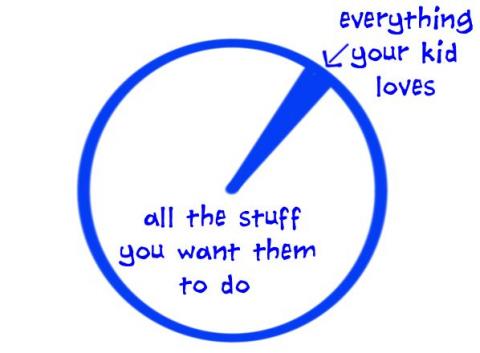
Many parents approach the subject of screen time — or other kid activities they don’t like, like reading comic books — by placing a strong limit on it. They say to their child, “We want our lives to be lovely and full of all the good things, so we are cramming all the stuff you love that we don’t like into this sliver.”

The child hears, “Blah blah blah, you love the sliver.”

Then the parents get to experience the ever-burgeoning frustration of having their child riveted on that sliver of time. The kids want to talk about it. They want to bargain for more of it. They want to argue about whether they got their fair share of it. Why? Because the sliver is where all the good stuff is.

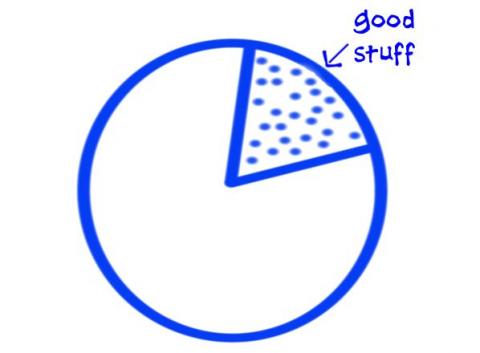
What we need to do is flip it around. Instead of making the sliver the garbage chute on Star Wars that everyone dives into for blessed escape, we need to allot the sliver to ourselves instead.

We say, “We want our lives to be lovely and full of all the good things, so we are going to allot a portion of our day to the stuff that really matters — the stuff we think is important.”

Now put it all in there. Make time every day to read, to play outside, to play a board game together, to build with LEGO or blocks, to spend time together in the art studio. Work on your projects together, side by side. Go for a hike, fly a kite, sit on the steps and eat an ice cream cone. Read aloud to one another.

As if by magic, the stuff you care about is now part of your everyday life. Magically, your kids are no longer riveted by the tiny sliver of time when they get to do what they want — therefore, they are free to enjoy all the good things instead of bitterly resenting them. Magically, you have just negotiated a life that respects both what is important to you *and* what is important to your child.

When you set up a scarcity situation, you are always going to whip people into a frenzy to get whatever it is that’s hard to come by, whether it’s a dancing Elmo, a Beanie Baby, or a half-hour playing Minecraft. That’s just human psychology. Make it rare and people want it desperately. And when you limit what your child wants to do and push them toward something else, saying THIS is better than THAT, you create conflict where there doesn’t need to be conflict. They should be able to love books *and* TV, computer games *and* playing outside. But because you have put these things in competition with one another, they have to choose — so they end up rejecting the very things you want them to embrace.

When you force your child’s interests into the sliver, you are denying them the opportunity to get good at what they care about. You are denying them the chance to relax and enjoy themselves. And you are saying, flat out, “I don’t care about this thing you like. I don’t like it.” That’s a path toward having them not talk to you about it anymore. You are forcing them away from you just when you should be pulling them close.

If they love Minecraft or playing a video or computer game, they can’t accomplish anything in a tiny slice of time. The way these games work, it usually takes a lot of time just to learn how to play and then it takes a lot of time to slowly progress to mastery. The games make you put in the time; they don’t let you jump straight to the fun part. And the kids are willing to do the work — but if they don’t have enough time, they can’t do the work.

It takes a lot of time to understand, grasp new concepts, figure out rules, learn, practice, and master. Kids whose screen time is limited are living in constant frustration because they can’t build their skills, they can’t watch the YouTube tutorials another kid made, they can’t learn what they want to learn, and they can never relax while doing the thing they enjoy most because they always have one nervous eye on the clock. They can’t experiment, they can’t explore, and they can’t practice — and those are the key steps of learning that you want them to experience, even when it’s doing something you yourself aren’t interested in.

Some parents say they’re really frustrated because their child seems to spend all of their available screen time watching *other* kids play — and they’re tempted to reduce the amount of computer time even more. But watching others is a crucial step in learning. What’s the fastest way to learn to ride a bike — reading a booklet about it or watching someone else ride? Plus, watching tutorials and watching friends play are community aspects; that observation helps them learn how to teach and mentor, how to collaborate and socialize. If you only get X minutes a day and you really want to learn, you are going to forgo playing yourself in order to try to cram in more learning time — and learning requires observing. So cutting back on their computer time actually forces them to do less hands-on experimentation. Learning by doing takes a lot of time, and they just don’t have that luxury.

One of our higher goals as parents should be to help our children become independent — not just physically, but intellectually. If we reject their interests because they seem stupid or because we don’t understand them or enjoy them ourselves, we are rejecting our kids themselves. Do you remember what you liked when you were 11? I’m pretty sure that’s the summer I played Monopoly nine hours a day, six days a week. On the one hand, it was very sedentary. On the other hand, I do own some real estate now. I haven’t built a hotel yet, but don’t count me out. I also watched a lot of “Love Boat” that year. Yet I still managed to start a company, open a school, and write a book. If “Love Boat” can’t kill your intellect, believe me, nothing can.

In our home, we limited screens naturally when our children were little by having a routine that just didn’t include them. When they got older, we employed generous limits. We didn’t use screens for entertainment (our family word for this is actually “sloth time”) until 3:00, which made their morning and early afternoon the focus of project work and play. As they got even older, we shifted that time to 2:00, but we also allowed computer use for project-related work because the boys were now researching independently, making films, writing books, and so on.

During the day, we worked on projects, played outside, read, played LEGO, took photographs, made art, and all the other good things. The kids never watched the clock; they never dropped a book or a squirt gun to dash to a computer or a TV set. They experienced balance and they enjoyed everything they did. There was no competition between computers and nature or between books and TV. Screens were fun, but the kids never riveted on them because there was no need to. If they wanted to get to level 47 of some game, they had plenty of time to do that. Employing generous limits means you have plenty of time. You don’t worry — there’s no urgency. You aren’t hyper-focused on it, and your mind is free to focus on and enjoy other things. And we made sure they had plenty of other things to focus on.

We need to shift from a scarcity model (there’s very little time for you to do those things you love to do) to an abundance model (there’s plenty of time for us to do all the good things, including that stuff you love to do).

You can’t really fix the sliver problem by, say, making the sliver a little bigger. It really takes a complete flip-flop. You have to stop curtailing what your child loves and instead focus on building a routine and a family culture around the things you believe are most important. Get those things in there — do them every day. But if you want your child to see them, appreciate them, and relax enough to enjoy them, think about getting rid of the sliver.

See also:

Why I Don’t Worry About My Kids’ Screen Time, Part 1

Why I Don’t Worry About My Kids’ Screen Time, Part 2

Parenting with abundance vs. scarcity

Friday link round-up

Published by Lori Pickert on May 3, 2013 at 08:38 AM

Welcome to Friday! Hope everyone had a great week. Here are the links I shared on Facebook this week (and some extra material as usual) with *bonus insightful comments*!

We spend a lot of time in the forum and in the PBH for Grown-Ups series talking about goals: how to set them, how to break them down, and then how to keep them. We talk about taking real baby steps — and in the forum, we have a thread where we support one another to set and work on monthly goals. An important theme is always — just keep going. Don’t give up. Any progress at all is better than no progress! So I liked this post about the marathon shuffle:

“The essence of the marathon shuffle is that, no matter how daunting it feels to add miles to your training runs, it’s entirely doable if you just keep shuffling out mile after mile.

And that is precisely what I kept top of mind throughout the training program, and all the way through that first race.

Just keep moving.

No need to sprint. Just keep shuffling forward.” — Too hard to sprint at your goals? “Marathon shuffle” at them instead

I used to have a handmade sign hanging on my computer right in front of my face: “Forge Ahead.” No matter how bad things get, no matter how slow you go, just keep going. As Churchill said, “If you’re going through hell, keep going.” I haven’t shared the following post on FB, but I keep sending people the link to underscore this point, so I’ll share it here:

[W]hen we consider our actions, often it’s true that any one instance of an action is almost meaningless, yet at the same time, a sum of those actions is very meaningful. Whether we focus on the single coin, or the growing heap, will shape our behavior. — Gretchen Rubin’s “One Coin Argument”

This hearkens back to the story of the two men who were asked about their work at a construction site: the first said, “I am laying bricks”; the second said, “I am building a cathedral.” Keep your focus on the cathedral you’re building — every brick counts!

Loved this old post by Rachel at Small Notebook about setting compelling goals. If you’ve doing some experimenting (by which I mean trying and failing) with goal-setting, you know they can be too small, too cloudy and undefined, and definitely too large and unwieldy. Compelling goals that are deeply meaningful can tap into our inner motivation:

Want a different life? Here’s how to do it:

Those things you’ve been calling dreams? Start calling those your goals.

And those things that you’ve been calling goals? Those are more like New Year’s resolutions: good for your health, but not quite compelling enough. You need bigger goals, captivating ones, audacious goals. The kind you’ll have to take risks for. — In Search for Compelling Goals @ Small Notebook

It’s scary to set big goals. But the people most likely to achieve big things are the ones who were brave enough (or crazy enough — probably a combination of the two) to attempt them in the first place. Speaking of which, this short video is definitely worth your time. In it, Roman Krznaric talks about how to find fulfilling work. I pulled out this short quote he referenced, and I think it speaks to the argument about whether you should pursue passion or just work hard:

“For the first time in the human experience, we have a chance to shape our work to suit the way we live instead of our lives to fit our work. We would be mad to miss the chance.” — Charles Handy

Hear hear. (Want to read more about the kickback against passion? Try this post: Why Skills Don’t Trump Passion. You can also check out last week’s link round-up.)

Roman talks about five strategies for finding work that is meaningful and fulfilling, which he defines as something you care about and something you’re good at. I’d say that’s at the heart of PBH.

Speaking of which, I shared a post about learners as entrepreneurs, which as you know is a favorite topic of mine:

“To cultivate creative and entrepreneurial talents is much more than adding an entrepreneurship course or program to the curriculum. It requires a paradigm shift — from employee-oriented education to entrepreneur-oriented education, from prescribing children’s education to supporting their learning, and from reducing human diversity to a few employable skills to enhancing individual talents.” — Learners as Entrepreneurs @ User Generated Education

Read my posts about raising entrepreneurs here: Entrepreneurship. Whatever you want to call the shift that is happening in our work world — freelance economy, gig economy — it seems clear that we need to prepare our kids to make their own jobs. Personally, I want to make sure my kids are prepared to both compete for a regular job they want *and* make their own job. Statistically, they will change jobs often, and we already know our career plans don’t always pan out. So I don’t think you can skip these crucial skills, even if your kid is sure he or she is set on “normal” employment.

This post is a little scattered and crams a lot into a small space, but there are some good, deep ideas there worth pondering:

“How do we find our authenticity with all of the many influences in our lives pulling us in different directions? One approach is to identify and make your own “authentic connections” with the people, places, activities or memories we relate to so deeply that they empower us to be more authentic.” — Authentic Connections and Growing Your Creative Confidence @ Forbes

Good thing to think about: authenticity. “Authentic” is a word that would loom large in the word cloud for PBH. Why? Because everything about PBH is about trying to make the learning experience more real, more learner-specific, and more relevant. I think we should be drilling deeper in every area of our lives to reach authenticity.

Another good thing to think about: self-efficacy. Another key part of PBH: having the *authentic* self-confidence that you can achieve what you are setting out to do. This ties back into goals — heck, it ties to everything. We’ll talk more about this in the future.

Okay, so some specific PBH-related goodness for this week — I shared this quote on FB, and it’s about leadership in business, but I want you to think about it in terms of mentoring your children to become self-directed learners:

“[I]t all starts with listening, turning our attention fully to the person we are with. It’s not just leaders, of course. We’re all besieged by distractions, falling behind on our to-do lists, multi-tasking.

A classic study of doctors and patients asked people in the physician’s waiting room how many questions they had for their doctor. The average was around four. The number of questions they actually asked during that visit with their doctor turned out to be about one-and-a-half. The reason? Once the patient started talking, an average of 16 seconds or so the doctor would cut them off and take over the conversation.

That’s a good analog for what happens … everywhere. We’re too busy (we think) to take the time to listen fully.” — Curing the Common Cold of Leadership: Poor Listening

We are leaders in our homes, and if we want to really mentor our children, we have to learn to stop, pay attention, and really listen. Good stuff.

Abbey shared a beautiful post about her five-year-old son’s foray into project-based homeschooling building a model of a Roman aqueduct:

“He got frustrated. … This frustration led to the most stunning moment of all, when he decided to build supports for the lower end of the aqueduct. …

I was sure [his plan] wouldn’t work. The pipecleaners were bendy…how were they going to support the weight of the wooden balls? When he tried it, though, I was surprised to see that although the pipecleaners buckled under the weight as the balls rolled down the chute, they popped back up again. The bendy pipecleaners made his design flexible where mine would have been rigid. His idea worked better than mine would have.” — Water Beads, II: Roman aqueducts and project-based learning @ Surviving Our Blessings

So much good stuff there, I want to just include the whole post — be sure to click over and check it out. This is the process *every* adult goes through when they support children to make their own ideas happen: the struggle to let go, the amazement when you see authentic learning happening. Authentic! This kind of learning is so much richer, deeper, and longer lasting than prescribed education. They own it. They know it. They will never forget it.

I hope you’re checking out the projects on the new PBH Kids blog. I got a great e-mail from a dad saying he was blown away and now is interested himself in helping his kids do more self-directed learning. We have the chance to inspire other kids *and* their parents — so let me know if you have some self-directed work to share!

Finally, I’m going to share a couple of inspiring quotes from the PBH forum. If you are interested in learning more about project-based homeschooling and sharing your exploration with other like-minded parents, join us. So much good stuff happening, good discussion, sharing, encouraging, and just all-around support.

We are not deeply involved in any projects that seem scholarly, but the play the girls have been involved in is intense and lasts for days. They’ve built a huge train track and have houses all around. Even their arguments are based on scenarios of what could happen where they are thinking through situations and using their imaginations for imaginary problem solving.
Play is how children learn! And if this doesn’t inspire you, nothing will:
I’ve been seeing things through fresh eyes again. Before breakfast, I grabbed a cardboard Top Ramen box I was going to throw out, and started sorting out our neglected craft box. I kept big ‘materials’ in that box, and transferred crafting ‘tools’ into the cardboard box — glue, pencils, scissors, rulers, thread spools, markers, etc. I sat this out for the kids and they were so excited! I also noticed that they were able to sort things, find things, AND put them back on their own today! No more ‘mom, where’s the glue?’ or ‘I can’t find my scissors!’
 
…
 
Also, today was our first official focused project day. It turned out great, and the kids were churning out more and more projects after they were finished. Our son, who only seems interested in video games, has been filling his new ‘project notebook’ with ideas! On a walk to the store today, I brought my first-ever mini notebook to jot down ideas as the kids mention them, and he actually said ‘Mom! Get your notebook back out! I have an idea!’
...all for our FIRST DAY... 

It doesn’t get any better than that! Have a great week, everybody!


Be a part of the PBH community. Project-Based Homeschooling isn’t for only one kind of homeschooler — whether you’re a classicist or a radical unschooler or somewhere in-between, all kids deserve some time to direct and manage their own learning while pursuing their deepest interests. Read the posts on project-based homeschooling. Check out the book. Look over the 10 steps to getting started with PBH. Join the forum. Chat with me on twitter. Follow me on facebook. See my pinterest boards on learning, authentic art, play, and more. Come make friends, get some new ideas, and brainstorm about your challenges.

“You want to build a family culture that celebrates and supports meaningful work. This is much more than saying the right thing — this is creating a lifestyle, a set of articulated beliefs, and a  daily routine that encourage and sustain the life you want for your family.” — Project-Based Homeschooling: Mentoring Self-Directed Learners

“I’m especially grateful for the shared experiences, questions, and suggestions in this forum. Already I have been able to think more creatively about some of our dilemmas and I think the idea of a tribe of families working on this makes it so much more interesting to me.” — from the PBH forum

This week on Facebook, we returned to the passion vs. mastery argument:

“Think about all the things you have been passionate about in your life. Think about all those passions that you considered making a career out of or building a company around. How many were/are there? Why did you bounce from one to another? Why were you not able to make a career or business out of any of those passions? Or if you have been able to have some success, what was the key to the success? Was it the passion or the effort you put in to your job or company ?

If you really want to know where you destiny lies, look at where you apply your time.” — Don’t Follow Your Passion, Follow Your Effort @ Blog Maverick

There were some strong reactions on Facebook voting in favor of passion. I wrote a post about this, if you recall:

To really learn something, you need both knowledge and skills. You have to gather the knowledge and then you have to work with it. To discard passion (or authentic interest) is to drain the life force from the learner and therefore from the work. Am I going to bring my best efforts to something that holds no interest for me? Am I going to achieve flow? Am I going to strive to challenge myself? — Why Skills Don’t Trump Passion

The thing is, in my opinion it shouldn’t be “passion over everything” — it should be “passion *plus* mastery.”

Skills don’t trump passion. Skills are what you know how to do. Passion is where you start finding out who you are, what you’re good at, and what the world needs. — Why Skills Don’t Trump Passion

I do think you should look at where you apply your time and your effort. Because if you think you have a passion but you aren’t willing to put in the time and the hard work to build up your skills, then what you have is a pipe dream. Real passion calls to something deep inside you that demands effort, sharing, and contributing. If you aren’t moved to do those things, then you need to consider whether it’s really a passion at all.

This week’s Facebook posts focused on self-examination, so let’s continue! Your passion may not really be much of a passion if you aren’t willing to do the work — and inspiration isn’t worth anything if it doesn’t lead to real doing.

“The inspiration is not the receiving of information. The inspiration is applying what you’ve received. People think that if they keep reading articles, browsing books, listening to talks, or meeting people, that they’re going to suddenly get inspired. But constantly seeking inspiration is anti-inspiring.


You have to pause the input, and focus on your output. For every bit of inspiration, use it and amplify it by applying it to your work. Then you’ll finally feel the inspiration you’ve been looking for.” — Seeking Inspiration? Stop Looking and Start Doing @ LifeHacker

This week’s theme is also evidently “share a quote then share one of my old posts” — here’s my take on too much inspiration, not enough action:
If attention is a finite resource, we need to be careful how we allot it.

If you have ever gotten caught on Tumblr or Flickr browsing 800 images of home offices, gardens, or kid spaces, you know what inspiration overload is. Especially when you find yourself addicted to looking at other people’s art projects and art studios but you haven’t touched a pencil yourself in ages.

The problem with too much input is, it leads to too little output. What is the point of endlessly gathering new information if we never do anything with it? — Inspiration Overload

In the same theme of examining our habits and determining whether they’re really supporting our goals, I loved this post about examining your social-media habits:

“Is it necessary to share this? Will it add value to my life and for other people?


Can I share this experience later so I can focus on living it now?


Am I looking for validation? Is there something I could do to validate myself?” — 9 Questions to Ask About Your Social Media Addiction

Click through to read the rest of the questions.
 
I don’t like framing this as social-media addiction for our context, however. Let’s frame it as self-reflection: taking the time to think about what we’re doing and why and whether our choices align with our goals. That’s worth thinking about!
 
It’s important to stop regularly and think about your goals. What do you want to accomplish? Do your routines and habits support those goals? Are you still feeling passionate about what you’re doing? Keri Smith has a great post about how to get published, and buried inside, she talks about how it’s about the journey, not the reward — the process, not the product:

But what I learned in the meantime was bigger than any publishing tip I had ever read, you really must LOVE THE WORK. While getting published is an exciting possible outcome of a creative endeavor, it should not used as a motive for creating. Really enjoy yourself and the process of creating… — Seven Steps to Getting Published, Keri Smith

In Reggio schools, they say Niente Senza Gioia — Nothing without joy. Measuring your joy is a good way of seeing if you’re still on track. Is hard work required? Oh, yes. Is it always fun? Nope. But you should still have the passion, you should still feel the drive to make and share and build, and you should still love the work. If you don’t love it, it’s not going to resonate with anyone else.


I hope you all have been checking out the new PBH Kids tumblr blog — I’ll slowly be adding more and more self-directed projects by kids of all ages, and we are going to have some kid-written reviews of project resources as well. If you want to share some kid-directed work, send me an e-mail through the contact form on this blog!


And finally, a great quote from the PBH forum:

I also loved what Ian told me yesterday — He said, “All of our projects connect! Because I am learning about the ocean, and Micah is learning about machines, and they use machines to explore the ocean, and Max is learning about dinosaurs and he is really wanting to know about fossils, and Lena is learning about people skeletons, and…” He’s right, they are all connecting, sometimes in startling ways.

Everything is connected.


On that note, hope everyone has a wonderful weekend!

Share your goals or keep them to yourself?

Published by Lori Pickert on April 22, 2013 at 08:30 AM

This post is part of my series on PBH for Grown-ups — you can see all of the posts here.

Should you announce your plans and intentions or keep them to yourself? Does it work for you or against you to share your goals with the people around you?

Reasons you might decide to share your goals:


1. Accountability. Other people will hold you to your plans. If you slip, they’ll encourage you.


How this can backfire: If you’re really doing the work, you will be constantly revising your goals. Other people won’t understand the nuances of your choices — if you don’t stick like glue to your original goal, they’ll say you’re making excuses. They’ll hold you accountable to your original, first goal, and that can be frustrating when you feel you need to adjust your sails. We already know we should avoid naysayers, but people who cheerlead you hard to stick with your original goal can be just as bad. There’s also the pervasive idea that you’re failing — even if you’re actually revising your goal based on new and/or better information.


Some people are great at encouraging; they are positive and supportive. Other people will tsk-tsk you, shame you, or tease you. If you share your goals at large, you’ll be getting all kinds of “support” when you slip.


2. Community. You’ll find other people who are working toward the same thing and you’ll all support one another.


How this can backfire: You want to write a novel, so you join a writing group. Terrific! People who are trying to write professionally supporting each other and giving each other valuable feedback … but is the feedback valuable? If you fold in everyone’s opinion, what happens to your original vision and your unique voice? Are these people really good writers, and is their advice any good?


The right community can offer support, encouragement, and valuable advice — but the wrong one can damage your work and your self-esteem along with it.


Finding community is tricky. You are on a journey to discover something entirely unique: yourself, your meaningful work, and your best life. The important thing is that you find the way that works best for YOU. Custom, not off-the-rack. Community sometimes drives toward sameness — there’s a right way and a wrong way. Two choices aren’t enough for you. You are looking for YOUR right way, and there isn’t a group for that. Get too entrenched in a particular community, and they may actually prevent you from growing.


3. Motivation. When things get tough, your friends can cheerlead you along.


How this can backfire: Are we looking for self-motivation or motivation from the outside? Sharing your goals brings on self-motivation to not embarrass yourself by failing in public. That’s not so great. A bit negative.


Then there’s the motivation you can get from others because they love you (friends, family) or they’re on the same journey (friends, community). That sounds better. Except we’ve already covered community: by definition, they’re mostly interested in an issue rather than you personally. They champion a particular way to reach a goal; they may not be so keen on helping you figure out exactly what works best for you and your family. Unless the community is  named “All About [Insert Your Name Here],” your goals and theirs are not 100% aligned. And we’ve already covered friends and family, too: As much as they may love you, their methods for encouraging you may not be what you need; in fact, they might work against you.


Thinking it through…


Do you need someone else to hold you accountable? If so, think about being your own trusted resource. Remind yourself of what you want to achieve and why. Build your supportive environment and advertise to yourself.


Do you need motivation? Stop and reflect often. Build a routine and habits that support reviewing your goals: keeping a journal, writing down your small wins, reflecting weekly/monthly/biannually about where you are, where you want to be, and how things are working. Ask yourself: Is this still what you want? Are you making progress? What specific steps do you need to take next? What tools do you need to take those steps? If you can’t break it down, you need to stop and figure out what comes next. If you no longer feel motivated, you need to ask yourself why. It’s no use having a group of people urging you on toward something that no longer feels meaningful.


Do you desire community? Don’t put all your eggs in one basket. Use different friends and groups for different things. Figure out which people leave you feeling energized and full of ideas and which leave you feeling negative and drained. Figure out what your groups and communities are good at and what they’re not so good at, and use them accordingly. Don’t fall into the trap of maintaining peace by pushing aside your own wants and needs.


Get this fixed in your mind: Our goals aren’t dreams. They’re plans. They’re intentions. We’re going to do the work to make them happen. We’re going to make slow but steady changes to align our daily activities with our values and goals. At some point, it’s the right time to share. At some point, we need to reach out and connect with other people. But we want to do it slowly, thoughtfully, and intentionally.


So what works for you — sharing your goals or keeping them to yourself?


For one more wrinkle, listen to Derek Sivers’ brief TED talk on the subject — he says that sharing your goals tricks your brain into thinking you already accomplished something, so it actually makes you less likely to succeed in the long run:

Repeated psychology tests have proven that telling someone your goal makes it less likely to happen.

Any time you have a goal, there are some steps that need to be done, some work that needs to be done in order to achieve it. Ideally, you would not be satisfied until you’d done the work. But when you tell someone your goal and they acknowledge it … the mind is kind of tricked into feeling that it’s already done. And then because you’ve felt that satisfaction, you’re less motivated to do the actual hard work necessary. — Keep your goals to yourself

Pages